On Wednesday 19 November 2008 Batman and Robin came to Broughton Castle in their Bat Mobile!
Is it a bird? Is it a plane? (Am I talking about the right super hero? -No!) Is it the real Batman and Robin? No!
It was some of the teachers, pupils and parents of local Frank Wise School (Banbury) filming part their Christmas 2008 show - which was premiered at the local Banbury Cinema in December.
Monday, January 26, 2009
Wednesday, January 21, 2009
Hornton ironstone at Broughton
It is from Hornton village about 6 miles away just up by Edgehill and the Warwickshire border.
Alec Clifton-Taylor in his 1972 "The Pattern of English Building" writes of it thus
"This beautiful stone, understandably beloved of sculptors as well as formerly for building, is unusual, inasmuch as deep brown, tawny yellow, greenish and greyish-blue tints can be combined within a single block."He goes on ...
"Only six or seven miles away from Hornton is Broughton Castle, one of the most lovable country houses in England, and almost without peer for the subtle beauty of its colour. The gabled walls are a mixture of grey and gold, grey-green and golden-green, and almost everything in between! Lichens add, here and there a gently mottled texture which is quite inimitable." Hornton is a Liassic ironstone. "All ironstones darken on exposure to the weather, since the particles of iron are soon oxidised to produce rust; this often yields richly satisfying hues."
Here is a 'richly satisfying hue' in the mirrored picture above. I took it on a simple little camera one evening in February last year from the park.
and just for comparison, a couple of showing how dramatically the stone changes - first on a grey autumn day, and then on a bright mid-summer's day.

Monday, April 28, 2008
"My yew fence of England. Who can stand against thee?"
March saw the return of the Pickwick Pepperpots to Broughton.
This is a Midlands-based longbow only archers club. About 80 bowmen (?) archers (?) - I'm not sure of the correct term - participated, firing at various 'marks' around the park.
One mark placed very close to the moat resulted in the loss of numerous arrows into the murky depths. As in 2007 the event finished with shooting at a target in the park from the roof of the Gatehouse.
Beautiful to watch, and strangely, to listen to; the noise of the bow releasing the arrow, and the arrow flights whistling through the air together. Even with just 80 archers you wouldn't have fancied your chances within a 30 foot radius of the target. Imagine 5,000 longbows at Agincourt firing 10 arrows a minute. Ouch. Some of the Pickwick Pepperpots have published rather good footage of the event on YouTube. The photo above was actually from the rather sunnier visit in 2007.
The races, and a dance in a marquee in the park the night before raised fantastic sums for the Banbury Young Homeless. Lots of fun had by all.
Only the sun was missing. Hopefully not too traumatic for the carp and perch and Cayuga ducks who I imagine took refuge over on the opposite side of the moat.
So, Old Subtlety returns. Perhaps another posting sooner than in 24 months :-)
Monday, March 06, 2006
You learn something everyday


A pillow mound.
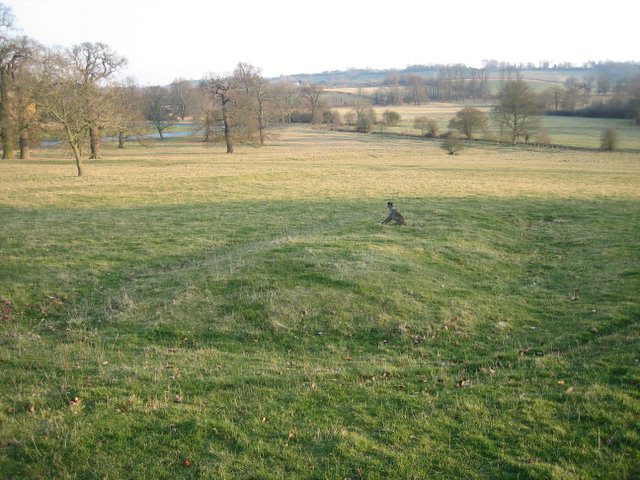
I think it is possible to make out this earthwork in the Park at Broughton from these pictures that I took at the weekend. Anyway it is a mound, about 30 feet by 8 feet, (the dog gives it scale).
Pillow mounds are part of the normal agricultural landscape from the middle ages and later. This one may be 16th century.
A pillow mound is for rabbit farming. You build up a false mound for your rabbits to make a warren in, and surround it with a trench. What sort of fence you used to keep the rabbits in I don't know.
This is just one of a number of unusual bumps and ditches in the park, but next time you walk your dog here (which, by the way, you are welcome to do) you'll know what this one is.
Monday, February 13, 2006
Lining the swimming pool

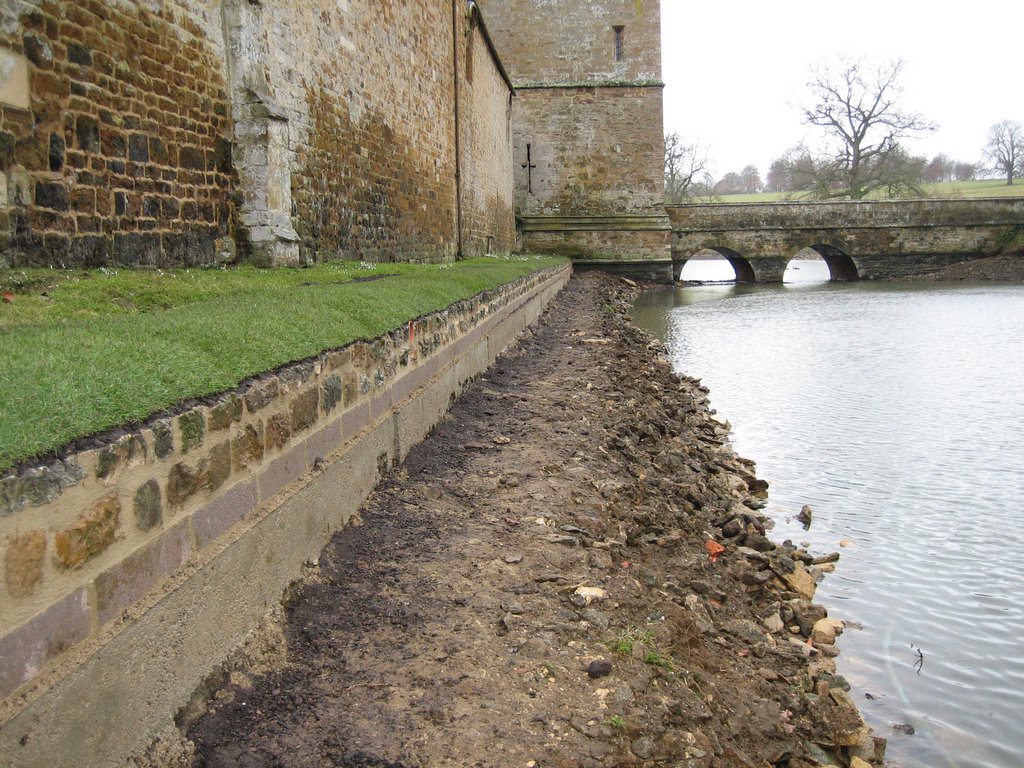
This winter's repair and maintenance work has involved emptying the moat to about a quarter of its normal volume, and tackling the deteriorating inner bank on the north side of the moat either side of the Gatehouse.
Time, the ducks and the beastly Canada geese are probably responsible for the gradual erosion of these banks. Perhaps even the many grass snakes living on various patches around the moat have also contributed. Not a lot of people know that grasss snakes love swimming - hence their latin name natrix natrix. It is only mildly alarming when swimming you see their little heads above the water as they wiggle their way from one bank to another. Enough digression - here are the banks - newly rebuilt with a concrete base and, for aesthetic reasons, stone on the top which will end up being visible above the water level. Cost prohibited doing the whole thing in stone.
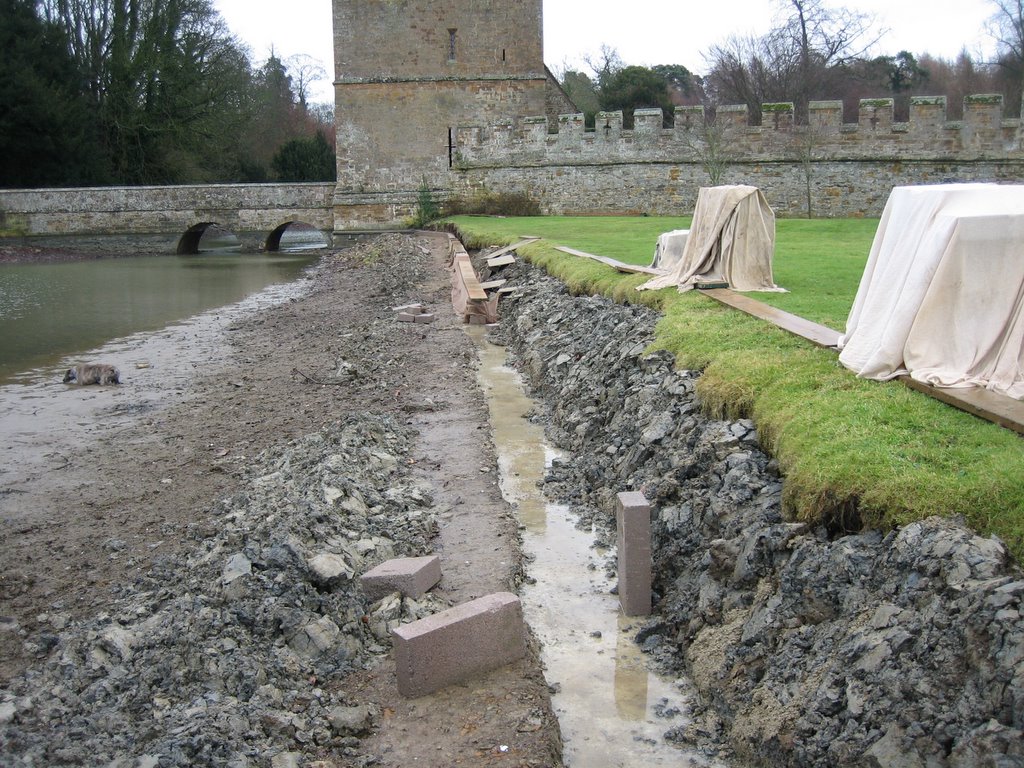
This side is still being finished, but you can see that here we are having to fill in between the eroded bank and what we assume was the original shore line. The filler here is the blue clay originally used to line the base of the moat when it was constructed in the early 15th century.
Subscribe to:
Posts (Atom)